
Board Member Job Description



Learn more about the role of the SOA Board of Directors.
Job Description
Responsible, in partnership with other Board members and staff, to lead the organization and the actuarial profession through implementation of the SOA Strategic Plan and by performing fiduciary, strategic and policy responsibilities.
Term
3 years[1]
Internal Relationships
- Build collegial and professional relationships with other Board members and key staff.
- Collaborate effectively with staff and leverage their expertise.
- Communicate questions or concerns through appropriate governance channels.
- Encourage member engagement and volunteerism within the SOA.
External Relationships
- Serve as an ambassador for the SOA and the actuarial profession.
- Promote collaboration among actuarial organizations and stakeholders.
Core Responsibilities
Governance and Strategy
- Understand and uphold the policies, and SOA Bylaws and other policies.
- Provide oversight of the SOA’s mission, vision, strategic plan, and governance policies.
- Monitor organizational performance, including strategic goals, budgets, and key metrics.
- Promote organizational values, ethical standards, and inclusive decision-making.
Fiduciary Oversight
- Ensure appropriate stewardship of financial and human resources.
- Approve the annual budget, operating plan, member dues, and fees.
- Review annual audit by independent auditor and act on recommendations.
- Oversee financial policies, investments, and controls through the Finance Committee.
- Ensure compliance with applicable laws and ethical standards.
- Avoid real or perceived conflicts of interest.
Board Operations
- Prepare for, attend, and actively participate in Board meetings and calls.
- Support effective implementation of Board decisions.
- Authorize and oversee committees and task forces as needed, including appointment of joint committees with one or more other organizations.
- Amend Bylaws and review committee actions, as appropriate
- Prescribe examinations and requirements for admission per Article III, Section 2, of the Bylaws
Professional Stewardship
- Stay informed of emerging issues affecting the profession.
- Support strategic planning and respond to periodic or unexpected organizational needs.
- Represent the SOA professionally in speaking and leadership engagements.
SOA Meeting Requirements
- Three in-person meetings annually (March, June, October), typically 1.5-2 days each, plus ½ day in preparation time.
- Spring Board meetings are typically held in March during the work week.
- Summer Board meeting is held in conjunction with the SOA Health Meeting, typically on a weekend in June.
- Fall Board meeting is held in conjunction with the SOA Annual ImpACT Conference, typically in October/November on a weekend.
- Approximately three additional virtual meetings will be held during the work week between regularly scheduled Board meetings and are 60 to 240 minutes long.
- Participate in incoming Board Member Orientation Meeting and other Board training opportunities in November (half day).
Board Assignments
- 3-6 hours per month on assigned committees or task forces. Board members serve at least two assignments. Executive Committee members have more time commitment (bi-weekly, hour-long meetings).
- Two to three in-person speaking commitments per year (may be international).
- You can find additional time commitment information.
Financial Support
- Travel and related expenses are reimbursed in accordance with Policy 330, Reimbursement policy
Qualifications
- Fellow of the Society of Actuaries
- CPD Compliant
- Demonstrates professional conduct consistent with representing the SOA.
Preferred Skills and Experience
- Engaged SOA member
- Possesses specific skills and experience identified as needed by the Board, including on AI, risk management
- Prior leadership experience within SOA governance, councils, committees, or task forces
Desired Competencies
Intellectual Engagement
- Strategic and innovative thinking
- Ability to assess risks, opportunities, and financial information
Stewardship
- Understanding of fiduciary responsibilities and governance principles
Ethics and Transparency
- Demonstrates integrity, objectivity, and ethical leadership
Collaboration
- Works effectively with Board members, volunteers, and staff
- Demonstrates cultural awareness and consensus-building skills
Commitment
- Demonstrated dedication to the actuarial profession and the SOA
- Willingness to meet the time and engagement expectations of Board service
Skills and Experience Profile
The Board Recruiting and Selection Committee, in close collaboration with the Board, developed a skills and experience profile that serves as a framework for identifying and evaluating candidates. Working with an external recruiting firm, the BRSC will use this profile to assess nominees based on how well they align with the sought-after skills and experiences. Every year, a defined set of skills and specific expertise and experience identified as current gaps on the Board will be published, enhancing transparency in the nomination process.
The visual below illustrates the skills and experience of continuing Board members across specified categories. A  circle indicates advanced knowledge, while a
  represents intermediate knowledge. A blank space indicates that the Board member has limited direct experience in this area but is knowledgeable and can engage in conversations on the topic.
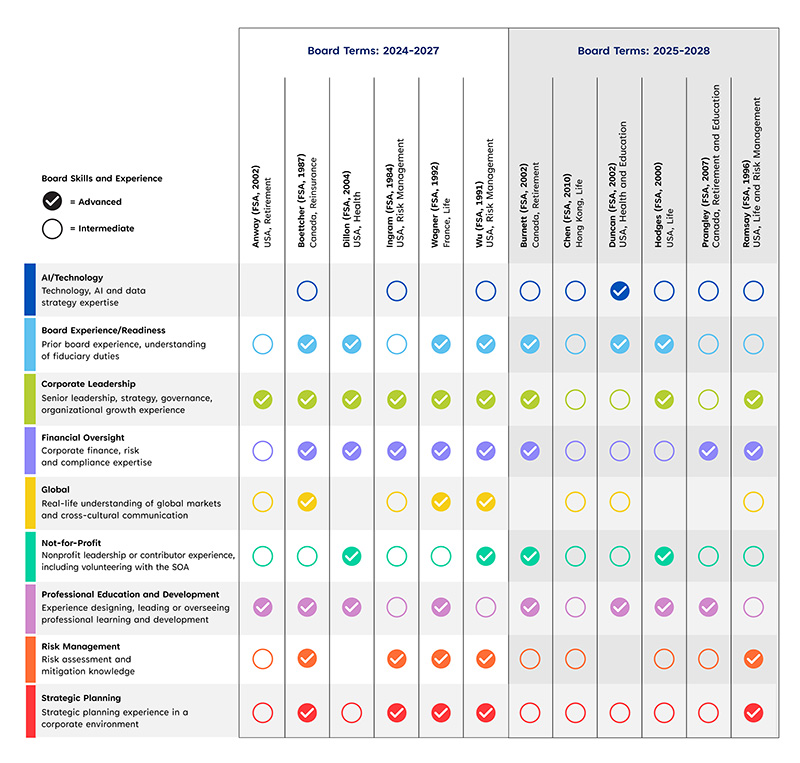
Find out more about each skill or experience. View/download a PDF of the current Board skills and experience profile
[1] Board Members can run for up to 2 terms as an Elected Board Member. However, they cannot seek election as an Elected Board Member following a term in a presidential office, even if they previously served only one term as an Elected Board Member.