

In an earlier article,[1] I offered a conceptual framework to explain the effects of remeasurements under GAAP’s current-assumption net premium methodology. That article was limited to circumstances when net premiums are less than gross premiums and the liability is greater than zero. In this article, I extend the framework to address the setting of net premiums equal to gross premiums. (This framework might also be useful in explaining universal life loss recognition, though its effectiveness there depends on the manner of measuring a loss.)
The focus remains on underwriting profit—the excess of insurance revenue over insurance costs (including liability accrual). The challenge remains to understand how events that alter expected cash flows shape the difference between expected earnings (the run rate) and actual earnings.
Key Concepts
As shown in the earlier article, performance under normal circumstances can be explained in terms of four key concepts with substantive meaning for general audiences.
- Fundamental gain—the contribution of an event to expected lifetime underwriting profit.
- Profit margin—the percent of lifetime revenue that is not needed to fund lifetime costs.
- Margin gain—the portion of fundamental gain that is presumed to represent profit.
- Shares of lifetime revenue—the ratios of revenue during a reference period to lifetime revenue.
Though capping of net premiums adds a layer to remeasurement, it reduces the number of key concepts that are relevant to an explanation.
Conceptually, when an event pushes the net premium ratio above the cap, expected lifetime profit becomes negative. When we cap the ratio, costs (and profits) are no longer matched proportionally to past and future revenue. As long as the constraint applies, shares of lifetime revenue are irrelevant to performance, and margin gain can’t be matched to future revenue.
Despite the cap, events will still produce changes in expected lifetime profit. Consequently, the fundamental gain remains relevant.

Capping the net premium ratio ( ) at 100% reduces the profit margin ( ) to zero. Profit margin remains relevant in transitions between profit and loss positions—when either (but not both) the prior or the updated margin is positive. It is, however, irrelevant while in a loss position.

The relevance of profit margin during transitions is found in the present value of future profit and the run rate.
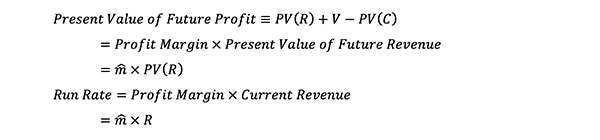
Setting aside the concepts of margin gain and shares of lifetime revenue, and recognizing the present value of future profit, we are now prepared to explain performance when a cohort hits the net premium cap.
Building an Explanation
Capping of net premiums does not alter the fundamental gain of an event. It does, however, change its matching to past and future revenue since expected lifetime costs are no longer matched proportionally to revenue.
Initial Capping
When a cohort enters a loss position, the fundamental gain is applied first to eliminate the prior present value of future profit. Whatever is left is recognized as the remeasurement gain. (Elimination of a positive prior value is a negative. Subtracting that negative makes the prior value an addition to fundamental gain.) In reducing the future profit margin to zero, the run rate (E) is reduced from its prior value to zero.
Upon transition into a loss position:
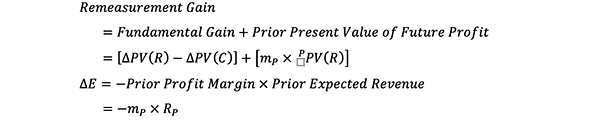
Actual underwriting profit is equal to the remeasurement gain. The difference from expected underwriting profit is, as in normal circumstances, the sum of remeasurement gain and the change in the run rate.
Continued Capping
While in a loss position, the present value of future profit and the run rate both remain at zero. Though events still produce a fundamental gain (which may be positive or negative) they have no effect on future profit as long as net premiums remain capped. Remeasurement gain is therefore equal to the fundamental gain and there is no change in the run rate.
While in a loss position:

Actual underwriting profit and the deviation from expected profit are both equal to the remeasurement gain.
Recovery
Should favorable events move a cohort back into a profit position, remeasurement will restore the proportional matching of expected lifetime costs to past and future revenue.
In this case, the fundamental gain is applied first to restore a present value of future profit and the remeasurement gain equals whatever remains. The run rate increases from zero to the product of the updated profit margin and updated revenue. (If the event driving the update is a deviation from expected performance, then updated revenue is equal to actual revenue for the period. If the event is an assumption change, then updated revenue is the new expected revenue.)
Upon transition out of a loss position:
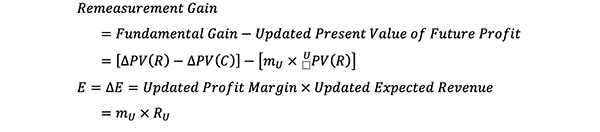
Actual underwriting profit and the deviation from expected profit are both equal to the sum of the remeasurement gain and the restored run rate.
In later periods, explaining performance will return to the normal framework described in the earlier article.
Illustration
The following illustration begins with an ordinary whole life insurance cohort at advanced issue ages. Originally issued with a 75.0% net premium ratio, adverse experience during the first three years has increased that to 93.2% (more precisely, to 0.93232). Past explanations of performance followed the framework presented in the earlier article.
Transition to a Loss Position
Going into year four, the run rate (expected underwriting profit) is $+525. Actual profit for the first quarter is $–75,011. Driving the difference is one material event—a mortality assumption change. (To simplify the illustration, we ignore any difference between actual and expected experience during the quarter. We’ll explore the dynamics of such an event in a later quarter.)
Updating the mortality assumption to be consistent with the observed pattern of adverse experience, the raw net premium ratio increases to 127.1%. The present value of revenue decreases from $180,910 to $129,523 (∆PV(R)=$–51,387) and the present value of costs increases from $172,730 to $208,598 (∆PV(C)=$+35,868) for a fundamental gain of $–87,255. In capping the net premium ratio, the fundamental gain is applied first to reduce the present value of future profit to zero, from its prior value of $+12,244 (0.06768 × $180,910). The remeasurement gain is equal to the remaining portion ($–75,011) of fundamental gain.
Along with the profit margin, the run rate is reduced to zero.
To summarize: Actual underwriting profit of $–75,000 is $76,000 less than expected. This includes a run rate reduction from $+1,000 to zero and a remeasurement gain of $–75,000. These result from a mortality assumption change that reduced expected lifetime profit by $87,000 (fundamental gain of $–87,000). With expected lifetime profit now negative, $12,000 of that represents an elimination of expected future profit.
Continuing Loss Position
As long as events do not return the cohort to a profitable position, expected future profit (run rate and present value) will remain zero and any fundamental gains will be recognized immediately in current income.
In our sample cohort, actual claims quickly turn favorable relative to the new assumption (though still adverse relative to the original assumption). Through the remainder of year four, actual experience reduces the raw net premium ratio to 123.5%, with actual income equal to the fundamental gain each quarter.
A detailed look at the first quarter of year five is representative of the analysis for each quarter while in a loss position. Actual underwriting profit of $+2,385 is driven by actual claims that are $3,460 less than expected. The difference between these two figures lies in the nature of the product—a permanent product at advanced ages. For this permanent product illustration, a substantial portion of a claim variance is offset by its secondary effect on persistency.
Updating for actual experience increases the present value of future revenue (∆PV(R)=$+1,345) and decreases the present value of future costs (∆PV(C)=$–1,040) for a fundamental gain of $+2,385. The raw net premium ratio decreases but, at 122.4%, remains above the cap so the run rate remains at zero.
To summarize: Actual underwriting profit of $+2,000 is more than the zero that we expected. Driving this result, actual claims were $3,000 less than expected. As a permanent product, however, such a variance coming late in the lives of the insured population increases expected future costs, reducing the fundamental gain to the $+2,000 that is recognized in current income.
Recovery from a Loss Position
With favorable experience continuing through the rest of year five, underwriting profit each quarter equals the fundamental gains produced by that experience. By the end of the year, the raw net premium ratio has been reduced to 119.7%.
In the first quarter of year six, we report actual underwriting profit of $+57,621 after making another assumption change.
Given the persistent deviations from expected experience, we reexamine our mortality assumption. This time, assume we find an industry study of products similar to ours in design and underwriting. Furthermore, we find close alignment between the study and our actual experience. Consequently, we change our assumption to align with the study.
This update increases the present value of future revenue (∆PV(R)=$+36,022) and decreases the present value of future cost (∆PV(C)=$–23,971) for a fundamental gain of $+59,993. The net premium ratio is reduced to 98.0% (more precisely, to 0.98023).
With the net premium ratio back below the cap, expected lifetime profit is again positive and must be matched proportionally to past and future revenue. Multiplying the updated profit margin (0.01977) and the updated present value of future revenue ($+126,127), we find a restored present value of future profit of $+2,494. This also restores a positive run rate ($+122, the product of the updated profit margin and $6,169 of current revenue).
To summarize: Actual underwriting profit of $+58,000 is more than the zero that we expected. Driving this is an assumption change that increased the present value of lifetime profit, a fundamental gain of $+60,000. Since the change returned the cohort to a profitable position, $2,000 of that is matched to future revenue. Though this restores a positive run rate, its amount is immaterial.
Conclusion
Capping the net premium ratio adds a layer to the key concepts described in the March 2026 article “Making Sense of Net Premium Updates.” Rather than complicating explanation, however, the added layer leads to a slightly different structure of explanation that is no more complex.
This structure may also prove useful with loss recognition for universal life contracts. Assuming loss recognition is aggregated at a level higher than individual cohorts, “capping net premiums” would mean setting benefit ratios to 100% for all cohorts in the aggregation—even those whose raw benefit ratio remains below 100%. Depending on how deficiency is measured and whether the aggregation includes cohorts that do not otherwise require an additional liability, this structure may only approximate reported results.
Disclaimer
This article is provided for informational and educational purposes only. Neither the Society of Actuaries nor the respective authors’ employers make any endorsement, representation or guarantee with regard to any content, and disclaim any liability in connection with the use or misuse of any information provided herein. This article should not be construed as professional or financial advice. Statements of fact and opinions expressed herein are those of the individual authors and are not necessarily those of the Society of Actuaries or the respective authors’ employers.
Steve Malerich, FSA, MAAA, is a retired actuary. He can be reached at sfmalerich@gmail.com.
[1] “US GAAP: Making Sense of Net Premium Updates,” Life and Annuities Newsletter, March 2026.