

This article describes a survey of 95 Chinese Generation Z respondents, the generation born between 1995 and 2010, exploring their awareness of and attitudes toward insurance products.
The life insurance industry in China is currently undergoing significant transformation and a need for innovation. The industry faces pressure to adapt to the shifting demographics, including younger populations and an aging policyholder base
As customers age, Generation Z may emerge as a greater economic force. In addition, as this group becomes a larger market segment, understanding their attitudes toward insurance may be increasingly important for insurers seeking growth opportunities. To understand them better, we completed the survey of Generation Z, resulting in 95 responses about their awareness of insurance products and factors influencing purchasing decisions. The survey sought information on factors that may influence Gen Z's purchasing decisions, such as recommendations from peers of the same age, cost-effectiveness of insurance products, ease of access to insurance information, and a company's reputation.
Due to the use of snowball sampling and limited survey size, this article is intended to offer potential directional insights rather than statistically representative conclusions.
Survey Overview
We conducted this survey using online and offline methods. The target population was individuals from Generation Z, and it included both students and employed individuals. The survey focused on two areas: Awareness of insurance products, and factors that influenced insurance purchasing decisions.
As this survey is based on a limited sample of 95 valid survey responses, the responses offer only a partial glimpse into the broader landscape
Given that the snowball sampling method is non-probabilistic and may introduce selection bias, and given that the offline recruitment was geographically concentrated, the survey responses are indicative of the views of the respondents alone rather than of findings that are statistically generalizable to the broader Generation Z population in China. To develop a more comprehensive understanding of Gen Z’s attitudes toward insurance needs, numerous additional approaches could be pursued. For example, establishing contact with respondents or their family members to conduct in-depth interviews, partnering with online communities and social platforms where Gen Z users frequently gather to extract behavioral data and analyze preferred topics. These represent valuable directions for future research expansion.
Respondent Characteristics
The ages of survey respondents ranged from 13 to 28 years old, which is in the Gen Z age range. The gender distribution among survey respondents was relatively balanced, with 44% identifying as male and 56% as female. Notably, a substantial percentage of the respondents, 68% or 65 individuals, were non-working students still completing formal education, the majority of whom were minors (aged 13–17). Their responses may have reflected aspirational preferences or parental influence rather than actual market behavior. Their attitudes, nonetheless, may offer insights into the emerging consumption patterns of the next generation of adult consumers.
Among employed respondents, approximately 50% had an annual income of less than 100,000 RMB, suggesting that they were either entering the workforce or had relatively modest incomes.
Approximately 50% of the survey respondents came from families with an annual income of around 200,000 RMB, suggesting that some of their families may have been financially stable.
Key Insights
Survey Respondents’ Awareness of Insurance Risks and Insurance Products
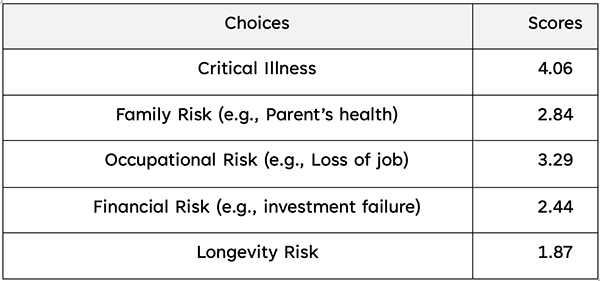
When faced with a range of risk scenarios, 59% of the Gen Z respondents (56 individuals) in this survey identified the risk of serious illness as their primary concern, followed by occupational risks. The current job market is highly competitive, and respondents exhibited sensitivity to factors such as unemployment upon graduation or layoffs by large companies. Those surveyed also indicated that they had concerns about employment prospects. (See Figure 1.)
Figure 1
The Gen Z participants in this survey demonstrated a basic understanding of China's current social medical insurance and pension systems: Over 80% of the survey respondents
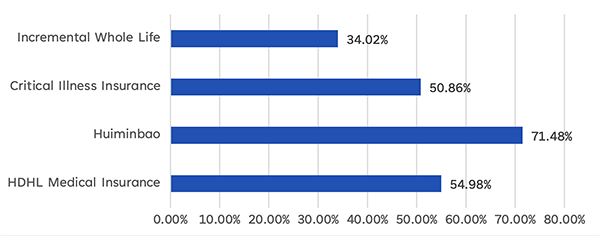
The survey respondents were somewhat familiar with commercial insurance, with HuiMinBao leading the pack at 71.48%, followed by HDHL (or Million Dollar) Medical Insurance at 54.98%, Critical Illness Insurance at 50.86%, and Incremental Whole Life Insurance at the bottom. (See Figure 2.) When they were interviewed, Gen Z respondents'
Figure 2
Respondents’ Willingness to Purchase Insurance
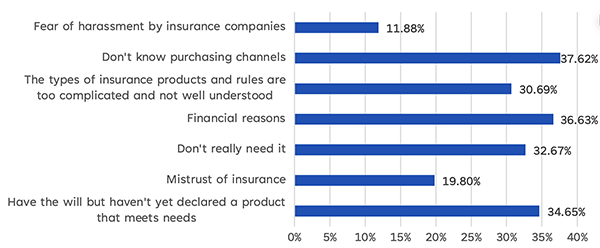
The survey responses suggested that 55.7% of the Gen Z respondents (53 individuals) had purchased insurance and were willing to continue doing so. This may indicate potential for promoting insurance to Gen Z. The reasons respondents gave for not purchasing insurance included financial constraints and a lack of awareness regarding purchasing channels, among others. (See Figure 3.)
Figure 3
While 81.4% of the Gen Z respondents expressed a willingness to purchase life insurance, over 84% indicated a willingness to purchase other types of insurance. (See Table 1.)
Table 1
Percentage of Respondents Willing to Buy Different Types of Insurance

There were subtle differences in the willingness to purchase insurance between employed and unemployed Gen Z survey respondents. Specifically, the employed respondents were somewhat less willing to purchase insurance in contrast to those who had not yet started working. (See Table 2.)
Table 2
Percentage of Respondents Willing to Buy Different Types of Insurance by Employment Status

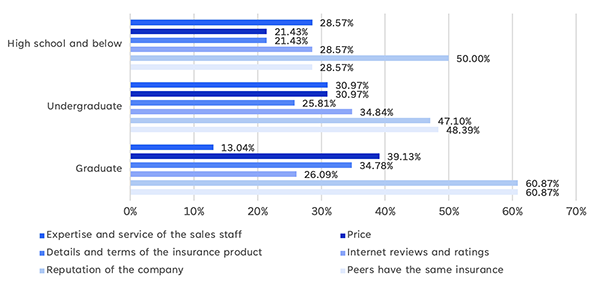
The survey respondents included 58 individuals who had completed undergraduate degrees, and 23 who had completed graduate degrees. The remaining 14 respondents had mixed educational attainments: Some were still earning a high school degree while others had earned a high school degree. Among the survey respondents, the higher their education level, the more likely they were to have valued peers' insurance choices in purchasing insurance. Across different educational completion groups the reputation of insurance companies emerged as an important purchasing factor among survey respondents. Price considerations appeared to matter more in purchasing insurance among graduate-level respondents. Among respondents who were employed, cost-effectiveness (price) appeared to be a more prominent consideration. (See Figure 4.)
Figure 4
Respondents’ Views on Insuring Family Members
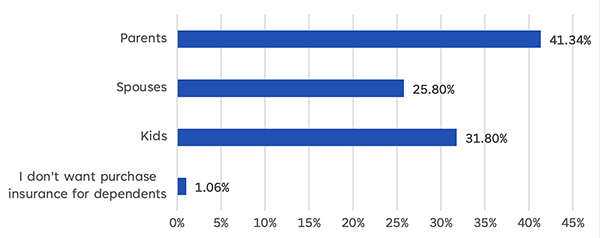
In this survey, 41.34% of the respondents expressed a wish to purchase insurance for their parents, and 31.8% for their children
Figure 5
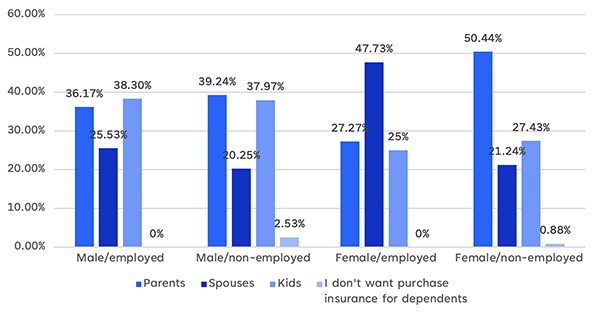
Among male respondents, responses suggested a preference for purchasing insurance for parents and children, and this pattern remained consistent across employment statuses. For female respondents, the intended beneficiary varied with employment status: The responses of those not yet employed suggested a stronger preference for insuring parents, while employed respondents appeared more likely to choose spouses. (See Figure 6.)
Figure 6
Factors that May Influence Gen Z Purchasing Decisions
Social Factors
Among the Gen Z respondents, 75.76%, or 72 individuals, expressed a willingness to consider purchasing insurance if recommended by friends and family.
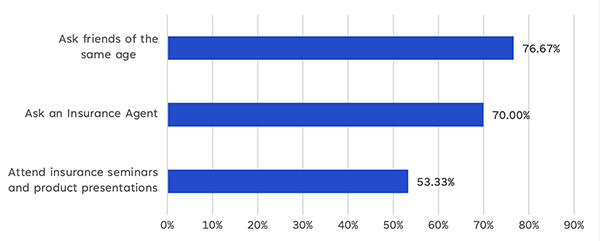
Among this group of respondents, recommendations from parents to purchase insurance appear to have had the most influence on insurance purchase decisions, followed by peer friends of the same age. The survey responses also suggest that respondents may have preferred to learn about insurance through peers, with friends of the same age ranking highest among the options presented. More formal ways, such as seminars, appear to have been preferred less. (See Figure 7 and Figure 8.)
Figure 7

Figure 8
Situational Factors
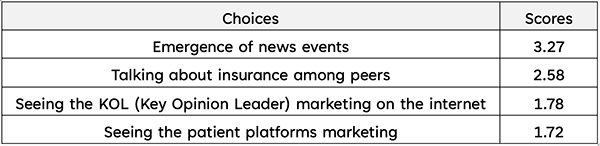
Survey respondents indicated that events covered in the news might influence their desire to purchase insurance. (See Figure 9.) During these times, individuals and families may experience a heightened need for protection. Natural disasters, accidents and health crises may serve as catalysts for a deeper understanding of potential future risks and uncertainties, and the value of insurance products may become more apparent, as they can provide individuals and families with financial support and protection.
With that said, promotions tied to sensitive events may be perceived as disrespectful and could harm a company’s reputation. Approaches that emphasize empathy and genuine support may be better received.
Figure 9
In What Scenarios May Gen Z Have a Desire to Purchase Insurance?
Perceived Factors Influencing Trust
Additionally, the survey responses suggest that while Gen Z may seek peers for insurance-related advice, reflecting a growing role of peer-to-peer information in the digital age, trust in insurance may be more strongly associated with excellence in claims records and customer feedback on credibility and strengths: 68.42% of Gen Z respondents, or 65 individuals, expressed trust in insurance companies with strong claims histories and positive customer reviews. (See Figure 10.)
Figure 10
Perceived Factors Influencing Trust in Insurance
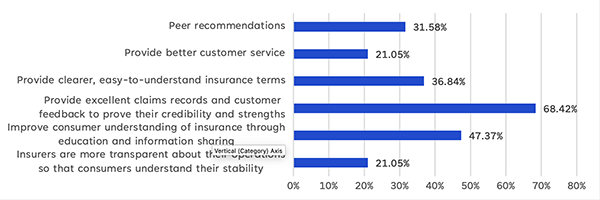
According to survey responses, 68.42% of the Gen Z respondents, or 65 individuals, appeared to view insurance companies with strong claims histories and positive customer reviews as trustworthy. Individuals seeking insurance typically regard claims as a fundamental necessity. Prompt and seamless payment in the event of accidents may be particularly important, and an insurance company that delivers stable and efficient claims service and receives positive customer feedback may be in a better position to gain market trust and attract customers.
Use of Digital Platforms for Information Searching
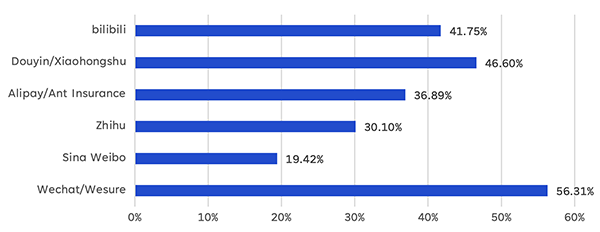
The Gen Z survey respondents appeared to prefer the platform WeChat/Wesure (an insurance platform developed by Tencent) most for insurance information searching. They appeared also to use Dou Yin (a Chinese version of TikTok), Xiao Hong Shu (known as Rednote, a lifestyle platform where users share product reviews, travel tips, and personal experiences), and Bilibili (a video-sharing platform known for its community around animation, comics, and gaming) for insurance information searching, reflecting the shift toward online communication suggested by other survey responses. (Figure 11.) It has been our experience that platforms such as Ant Insurance, Wesure, and Water Drop Insurance have been used broadly to distribute information about a diverse selection of insurance products, including HuiMinBao, high deductible & high limit (HDHL) medical insurance, and critical illness insurance.
Figure 11
Premium Expectations
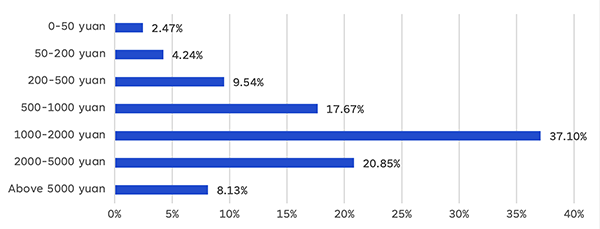
According to the survey responses, more than 80% of the respondents, or 76 individuals, indicated that they could afford more than 500 RMB per year on premiums for insurance products, with 37.1% of the survey respondents indicating that they could afford in the range of 1,000 RMB to 2,000 RMB. (See Figure 12.)
Approximately a quarter of respondents reported that they could afford products that cost 2,000 RMB or more, and some noted that service quality was a key expectation for higher premium products.
Figure 12
Author Discussion and Considerations
Given the characteristics of Gen Z consumers discussed in this article, insurance companies could consider the following strategies: Introducing more flexible insurance products and policy terms, allowing consumers to make choices and adjustments according to their individual needs, and providing personalized insurance solutions to meet the diverse needs of Gen Z. In addition, insurers could explore continual product innovations to adapt to changing market needs and consumer expectations.
In terms of product development, insurers could consider providing value-added services to enhance the attractiveness of their products or developing new insurance products to meet specific risks and needs through in-depth research on market trends and consumer needs. In addition, insurance companies could examine whether segmenting Gen Z by different genders and whether they are employed or not might reveal different needs, and design differentiated products for different tiers within the group. For instance, term life insurance with health services could be considered as a potential option for Generation Z, who are new to society and likely have limited income.
In terms of media marketing and word-of-mouth communication, insurance companies could consider providing insurance education and case sharing to Gen Z through agent training and cooperation with professional insurance brokers. This may help improve awareness of their insurance needs, as well as those of their parents.
Digital transformation could represent another area for consideration, with insurers potentially expanding efforts to provide online insurance product comparison, purchase, claims, and consultation services to Gen Z.
In the price sensitivity area, insurance companies could consider a range of approaches:
- Insurers could explore offering more competitive pricing by reducing operating costs through cost structure optimization, efficiency improvements, and digital technologies. In addition, partnerships with reinsurers could be considered to reduce the cost of risk, further lowering insurance product prices.
- Simplifying product design could be another option to consider. By removing complex terms and additional insurance, insurers might create more straightforward and understandable insurance products. This approach may help insurers balance price considerations with service quality, aligning with the preferences or needs of Gen Z.
This article is provided for informational and educational purposes only. Neither the Society of Actuaries nor the respective authors’ employers make any endorsement, representation or guarantee with regard to any content, and disclaim any liability in connection with the use or misuse of any information provided herein. This article should not be construed as professional or financial advice. Statements of fact and opinions expressed herein are those of the individual authors and are not necessarily those of the Society of Actuaries or the respective authors’ employers.
Mingyan Wang, FSA, currently works for China Life Reinsurance as assistant general manager in charge of product development.
Weiqin Guo, ASA, currently works for China Life Reinsurance as an actuary in product R&D.
Yuzhi Tian is a student at University of California Santa Barbara.