

The Modeling Boot Camp (MBC) is an opportunity for new and experienced modelers to gain a solid understanding of modeling fundamentals. Sponsored by the Society of Actuaries’ Emerging Topics Community, the MBC has been offered annually since 2021. For the past three years, it has been my privilege to co-lead and help organize the MBC, and I hope you will consider joining us in 2026!
The MBC focuses on modeling in the context of actuarial science. The growing importance of principle-based valuation for life products, encapsulated in VM-20 for life insurance, VM-21 for variable annuities, and VM-22 for fixed annuities, has increased the importance of sound modeling techniques. But modeling concepts are also important in other fields where models are used to measure outcomes to problems that don’t lend themselves to closed-form solutions. Pensions, health, property and casualty insurance projects can benefit from the application of MBC concepts, with models playing a prominent role in pricing, risk management and valuation in all of these areas. Outside the insurance world, modeling is used in the fields of engineering, economics, biology, meteorology and other sciences. Recognizing this, attendance is not limited to actuaries—attendees needn’t even have taken a single actuarial exam!
The MBC is a five-day virtual seminar conducted in mid-summer. For 2026, the MBC will take place during the week of July 27 – 31. While the syllabus is geared toward people who are new to modeling, even those who have already spent some time in this world may find it helpful to learn more about the disciplines needed to model properly. For 2026, the five days will cover the following:
-
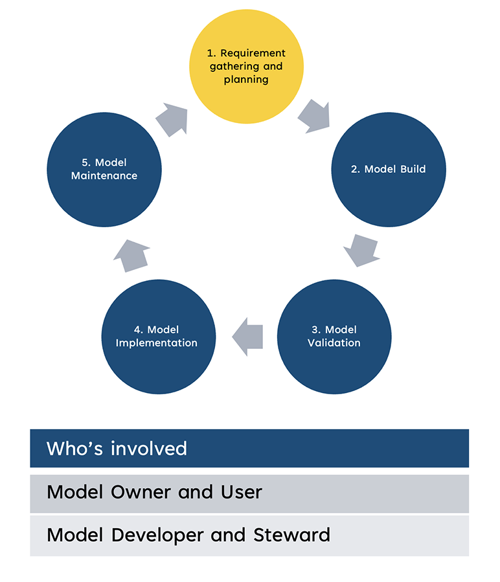
Day 1: Model structure, team organization and life cycle management (See Figure 1). Learn about roles played by team members, including model developers, owners, users and the model steward.
Figure 1- Model Life Cycle
- Day 2: Data and assumptions. We discuss the importance of data validation and development of sound modeling assumptions.
- Day 3: Model limitations and simplifications. There is a particular focus on model efficiency—techniques to make models run faster without loss of accuracy.
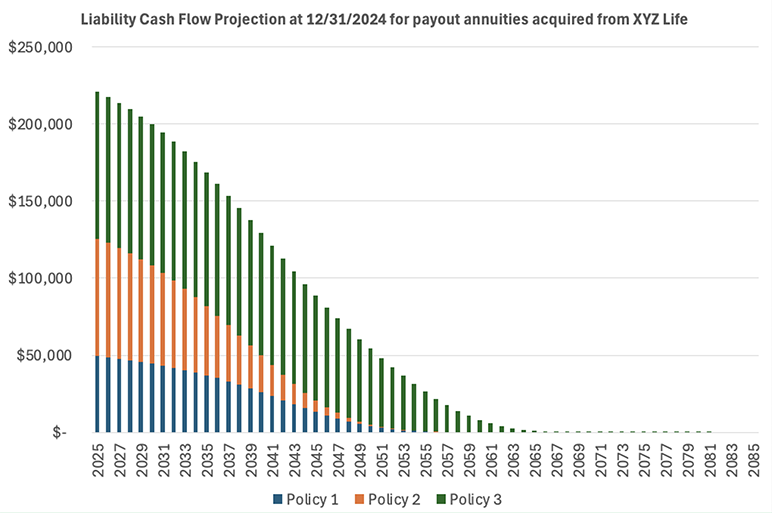
- Day 4: Documentation, communications and the role of new tools. Learn how documentation can help with model validation (See Figure 2), and how to use tools like data visualization and cloud computing.
- Day 5: Artificial Intelligence and software engineering. Learn to think like a software engineer, and how to use AI to speed model development.
Figure 2
Example of Model Output Documentation
Each day is a 90-minute session conducted via Zoom. We view a pre-recorded video on the subject of the day, then go into breakout discussion groups to cover questions related to each video and to reinforce key concepts. Homework assignments allow participants to apply concepts learned each day in the context of a real actuarial model. Participants are encouraged to bring their own models to use in homework assignments, but the SOA provides a “default” model for those who don’t have one. Participants share findings from each night’s homework assignment at the start of the following day.
The MBC faculty consists of several FSAs who bring deep modeling experience and a passion for modeling well. They present the syllabus, lead the breakout discussion groups and encourage discussion of alternative solutions to each night’s homework assignment.
To encourage the exchange of ideas through group discussion, subscription to the MBC is limited. Applications are accepted on a first-come, first-served basis. Each year since 2021, the number of applicants has exceeded the limit.
So, what do you stand to gain from the MBC? If you are new to modeling, it’s a chance to lay a solid foundation upon which you can grow into a skilled modeler. If you already have considerable modeling experience, it can fill in the gaps in your knowledge and get you up to speed with the current state of the modeling art. And if you come from outside the actuarial profession, it’s a chance to learn techniques developed in the actuarial world and transfer them to your own field. As a co-leader of this program, I have learned a lot from MBC interactions, and you can too!
This article is provided for informational and educational purposes only. Neither the Society of Actuaries nor the respective authors’ employers make any endorsement, representation or guarantee with regard to any content, and disclaim any liability in connection with the use or misuse of any information provided herein. This article should not be construed as professional or financial advice. Statements of fact and opinions expressed herein are those of the individual authors and are not necessarily those of the Society of Actuaries or the respective authors’ employers.
Bob Leach, FSA, retired from paid employment in 2024 after 47 years of work in the actuarial profession. He is a co-leader for the Society of Actuaries’ 2026 Modeling Boot Camp and is article co-lead for the Emerging Topics Community. Bob can be contacted at bobleachfsa@gmail.com.