

Actuaries and risk managers must maintain a forward-looking perspective. Regardless of whether they are directly involved in risk management, the Own Risk and Solvency Assessment (ORSA) process, or the Emerging Risk Management (ERM) function, it’s essential for them to grasp the evolving dynamics not only within their organization and industry, but in the wider world as well, in order to meet their professional responsibilities. In other words, staying informed about emerging risk trends is a key component of effective risk management.
The Emerging Risks Survey, published annually by the Society of Actuaries (SOA) Research Institute and the Casualty Actuarial Society (CAS) can be a crucial risk management tool. Findings from the 19th annual Emerging Risks Survey, fielded in January 2026, were recently published.
Each year, the organizations distribute an online questionnaire that asks risk managers to consider different hazards that have been divided into various categories and rank them in four ways:
- Top current risk
- Leading five emerging risks
- Overall emerging risk
- Emerging risk combinations
This year, the survey asked risk managers about 17 risks under five categories.
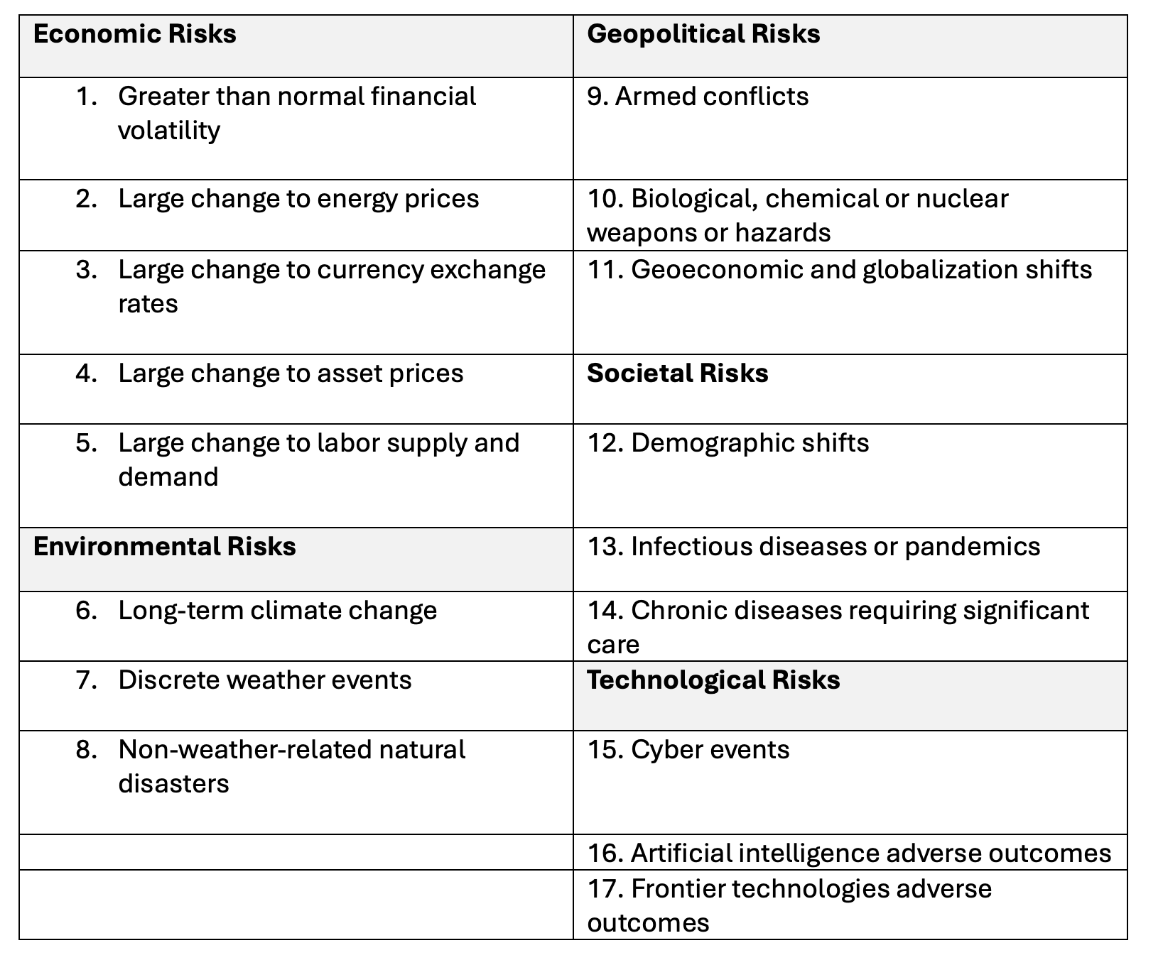
Risk managers can also comment on additional risks beyond the main categories. For instance, they may consider how blockchain and asset tokenization affect global payment systems or how large technology companies with access to real-time personal data (e.g., health-monitoring watches, telematics devices) could threaten existing insurance company business models.
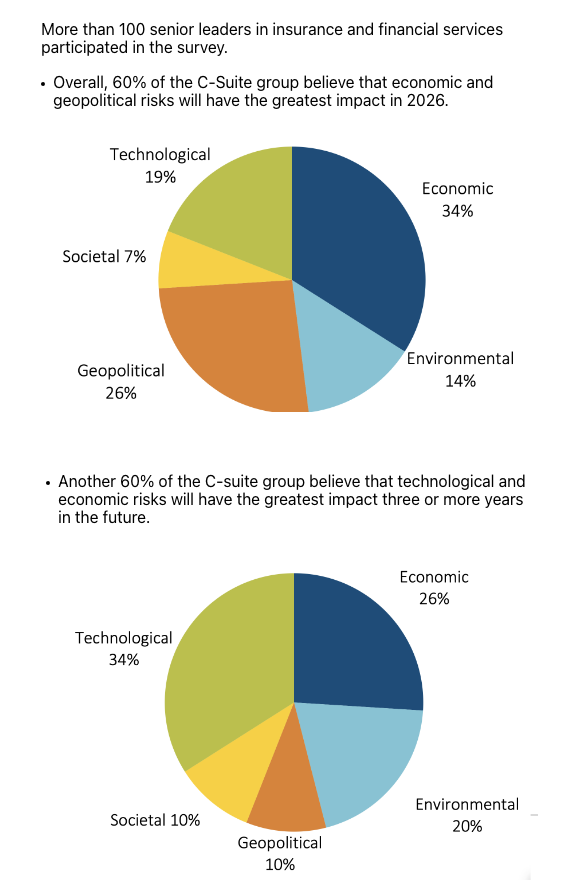
Now in its 19th year, the survey’s longevity enables researchers to collect the perspectives of risk managers over time and discover trends that reach beyond the usual planning cycles in the insurance sector. The survey gives actuaries and enterprise risk managers a heads-up on what risks are top of mind right now, using lessons from past data. The results offer a big picture view and encourage everyone to step back and spot the bigger trends.
Scanning the Horizon
This article provides an overview of why identifying emerging risks is important and how the information from the Emerging Risks Survey findings reports can be applied to risk management. For more details, please download the SOA Research Institute’s Emerging Risks Survey: Guide for Use, which is a handy resource for making the most of the Emerging Risks Survey reports.
Overall, the survey results empower actuaries to look ahead by leveraging historical data, and they keep ERM professionals informed about the most relevant risks facing the insurance industry. The findings also offer a wide perspective, covering geopolitical, societal, technological, economic and environmental factors. By encouraging both survey respondents and readers of the report to step back and consider the bigger picture, the survey helps everyone spot important trends and understand how risks are evolving.
Those who pay attention to risks on the horizon have the opportunity to develop plans early on and improve their chances of mitigating or even avoiding the potential ramifications of those risks. A risk manager doesn’t need perfect foreknowledge to plan for potential hazards, but there is value in thinking about scenarios in advance. Doing so gives an organization a head start over those who didn’t recognize the risk as early, and this could translate into a competitive advantage.
Developing a Gameplan
The risk manager role requires knowledge of risk exposures along various timelines. An immediate emergency affecting an organization would be an obvious priority, but, barring that, a risk manager should focus on volatile events that may happen within a year while also taking a longer view in the three-to-five-year range. And an even more strategic point of view would involve looking as far out as 10 years. Emerging risks can include both positive opportunities and hazards. Additionally, learning how risks could interact with each other gives risk managers even greater foresight.
Foresight in Action
Risk managers should use all available tools, including the Emerging Risk Survey, to maximize their foresight and translate it into decision-making. Forecasting involves recognizing interactions between risks and aggregating them, and this can be difficult because emerging risks can arise at any time to disrupt even the most carefully thought-out plans. For instance, while some assumptions tend to return to their usual patterns over time, others can drift further from stability, sometimes resulting in what’s known as a Minsky moment, when financial bubbles become apparent and eventually burst.
Where Data Ends, Insight Begins
When historical data can reliably predict the future, risk management is straightforward, and AI tools excel at spotting patterns in this context. However, humans bring valuable holistic insight, especially when it comes to understanding how risks interact and aggregate, or how feedback loops and emerging risks can disrupt linear forecasts. Ultimately, emerging risks challenge us to identify “unknown knowns,” where past trends may not guide future outcomes.
Importance of Experience
Hindsight comes from referring to past experience to detect changes on the horizon and anticipate responses when similar events happen in the future. For example, those who anticipate recessions based on historical cycles can fine-tune products and investments earlier than those who don’t. An experienced professional can often spot when big changes are coming that might make current models outdated. Big data gives us a lot of information, but it doesn’t always help us notice when things have truly shifted. That’s why combining expert insight with data analysis leads to the best results. Each approach makes the other stronger.
Navigating Complexity
Progress isn’t linear. Our world is shaped by many moving parts that interact in complex ways. While it can be challenging to understand how these interactions work, it’s definitely possible. By keeping track of both internal and external events and taking time to review what happened and why, we can learn valuable lessons and improve our processes for the future. Truly unpredictable events, so-called “unknown unknowns,” are actually quite rare. For example, although the COVID-19 pandemic caught many off guard, experts had long warned that a new virus could disrupt health systems, supply chains, and financial markets, but those warnings often went unheeded.
It’s important to regularly review “rules of thumb,” especially when things aren’t following the expected patterns. Since the world is always changing, those who don’t adjust and adapt may find themselves left behind.
Final Word: Lead With Insight
The Emerging Risk Surveys aren’t meant to crown permanent champions among risks; they’re a momentum read. In a world where “everything is rising,” you have to choose. The trick is to choose visibly and intelligently, understanding why something jumped up the list this quarter and what you’re doing about it. That’s good risk management and good leadership.
To learn more, download the SOA Research Institute’s 19th Emerging Risks Survey report and the Emerging Risks Survey: Guide for Use.
This article is provided for informational and educational purposes only. Neither the Society of Actuaries nor the respective authors’ employers make any endorsement, representation or guarantee with regard to any content, and disclaim any liability in connection with the use or misuse of any information provided herein. This article should not be construed as professional or financial advice. Statements of fact and opinions expressed herein are those of the individual authors and are not necessarily those of the Society of Actuaries or the respective authors’ employers.
Dale Hall, FSA, MAAA, CERA, is managing director of research for the SOA Research Institute. Dale can be contacted at dhall@soa.org.