

From Automation to Autonomy
For decades, the actuarial profession has stood at the intersection of analytical rigor and technological evolution. From hand-cranked calculators to high-performance computing and machine learning, actuaries have consistently adapted their tools to serve a constant purpose—transforming uncertainty into insight. Yet, a new wave of artificial intelligence is once again reshaping the landscape. This time, it’s not just about faster computation or better predictions; it’s about intelligence that can act.
Enter Agentic AI—a form of artificial intelligence that doesn’t just analyse data or generate responses, but perceives, plans, acts, and learns autonomously to achieve defined goals. Unlike traditional automation, which follows fixed rules, or generative AI, which produces content in response to prompts, Agentic AI can take initiative. It can decide what steps to perform next, adapt to new information, and improve through experience—all while staying aligned with a human-defined objective.
This shift from automation to autonomy is quietly transformative. Imagine an AI agent that not only prepares data for a valuation run, but also identifies inconsistencies, suggests corrections, and documents every adjustment. Or a digital assistant that can execute model test suites overnight, flag anomalies, and draft summary reports before the team logs in the next morning. These are not far-future concepts—early versions are already being tested in actuarial transformation programs across insurers and consulting firms.
As the profession stands at this new frontier, one question becomes increasingly relevant: How will Agentic AI reshape actuarial work—not just what we do, but how we think, collaborate, and deliver value?
The following sections explore transformation from the evolution of AI in actuarial practice to real-world use cases, emerging skills, and the ethical frameworks needed to govern this new era of actuarial intelligence. The following sections explore the transformation from the evolution of AI in actuarial practice to real-world use cases, emerging skills, and the ethical frameworks needed to govern this new era of actuarial intelligence.
The Evolution of AI in the Actuarial Ecosystem
Technology has always been woven into actuarial DNA. Each generation of actuaries has found new ways to balance analytical discipline with computational power—from hand-coded valuation programs on mainframes to sophisticated cloud-based models today. The journey of AI in this space mirrors that same pattern: Slow adoption at first, followed by rapid integration once its business value becomes clear.
The first wave of automation focused on efficiency. Batch scripts, macros, and workflow schedulers reduced manual effort but remained rule-bound—repeating exactly what humans defined. The second wave, powered by machine learning, added pattern recognition. Actuaries began using predictive models to analyze experience data, detect trends, and support assumption reviews. Yet these systems still depended on human triggers: Someone had to feed data, run models, and interpret results.
Now the third wave is emerging—the era of Agentic AI, where systems act with limited supervision. These agents don’t wait for instructions; they pursue objectives. A valuation agent might monitor nightly runs, identify mismatched policy counts, and rerun selected cases automatically. A data-quality agent could reconcile multiple data sources, explain anomalies, and update dashboards in real time.
What drives this shift isn’t only technology; it’s necessity. Actuarial models are larger, data pipelines more complex, and regulatory cycles shorter. Human review alone can’t scale indefinitely. Agentic AI offers a new operating model—one that combines automation’s reliability with adaptive intelligence.
This evolution also reflects a cultural change. Earlier automation reduced workload; today’s AI expands capability. Actuaries are no longer just users of software but designers of intelligent systems. Collaboration between actuarial experts, data scientists, and AI engineers is creating a new discipline where professional judgment meets computational reasoning.
In many organizations, early signs are already visible: AI-driven data audits, autonomous test agents in model migrations, and copilots assisting with assumption documentation. Each success strengthens the case that Agentic AI is not a passing trend but the logical next stage in actuarial modernization.
Inside Agentic AI: What Makes it Different
To understand the impact of Agentic AI on actuarial work, it’s important to recognize what makes this technology fundamentally different from traditional automation or even advanced machine learning models. At its core, Agentic AI isn’t just about intelligence—it’s about initiative.
Most AI systems today are reactive: They wait for a query, input, or dataset. Agentic AI flips this model. It behaves more like a junior analyst who knows the objective, understands the context, and can decide which steps to take next. This autonomy is powered by a simple but powerful cognitive loop. See Figure 1 below.
Figure 1
Continuous Human-Supervised Intelligence Loop
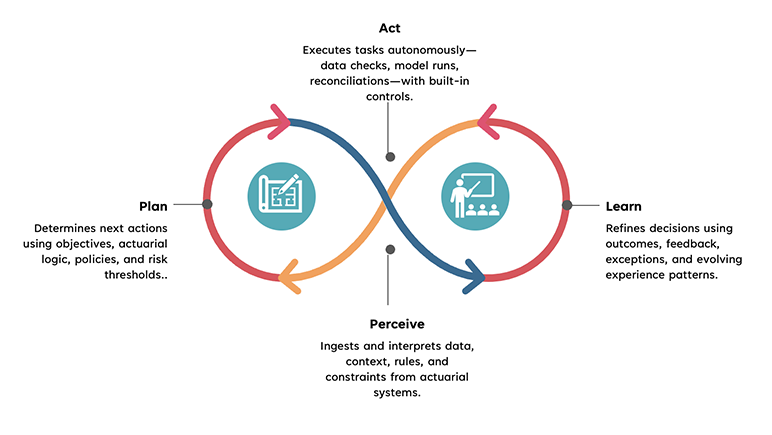
What makes this especially relevant for actuaries is not autonomy alone, but the structured reasoning behind it. Agentic systems can interpret actuarial rules, understand dependencies, and apply logic across multi-step processes. This means they can take on tasks that previously required a human’s judgment-like reasoning, such as:
- Identifying patterns in lapses or mortality experience that warrant deeper investigation,
- performing multi-stage data checks and documenting each correction,
- running a sequence of model tests and summarizing exceptions, and
- monitoring assumption changes and their downstream effects.
The result is a new class of digital worker—one that can scale with complexity, maintain consistency, and operate continuously.
As Agentic AI becomes embedded across actuarial workflows, the nature of actuarial intelligence itself expands. Instead of simply automating tasks, organizations can automate thinking patterns—while actuaries provide oversight, context, and ethical judgment.
Reimagining Actuarial Workflows: Where Agentic AI Is Delivering Impact
Agentic AI is no longer a theoretical concept—it is actively reshaping actuarial work by combining autonomy with domain-aware reasoning. Its impact is most visible in areas that are repetitive, rules-driven, and heavily dependent on data quality, documentation, and reconciliation. More importantly, it is not just improving individual tasks; it is reimagining actuarial workflows end to end.
Table 1 below, identifies the key areas where agentic systems deliver measurable value while fundamentally changing how actuarial work is performed.
Table 1
Agentic AI as a Catalyst for Actuarial Value Creation
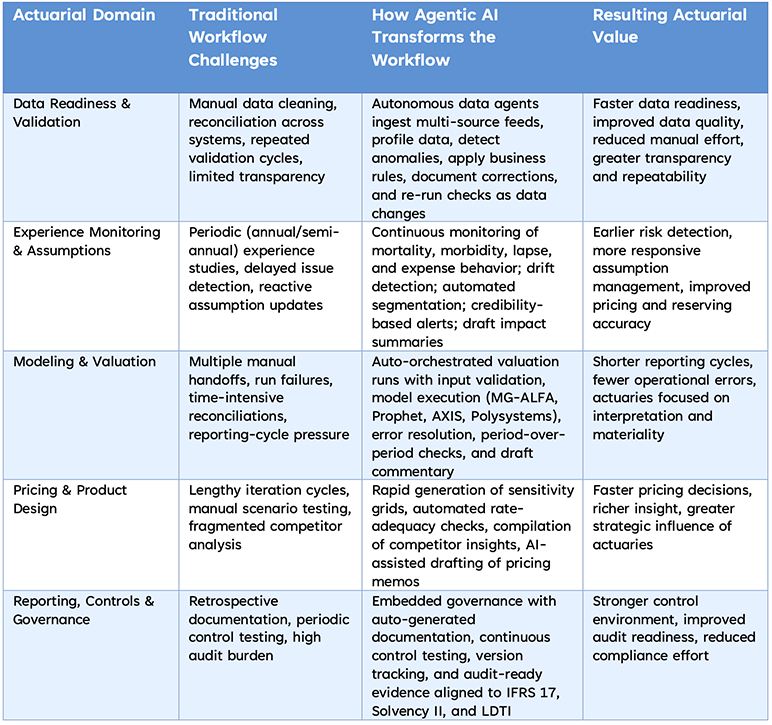
The Transformation at a Glance
Across these areas, a consistent pattern emerges. Agentic AI acts as an always-on workforce layer—detecting, executing, and documenting operational tasks—while actuaries focus on judgment, interpretation, and strategy.
Actuarial workflows evolve into an integrated ecosystem. See Figure 2 below.
Figure 2
Agentic AI–Enabled Actuarial Ecosystem
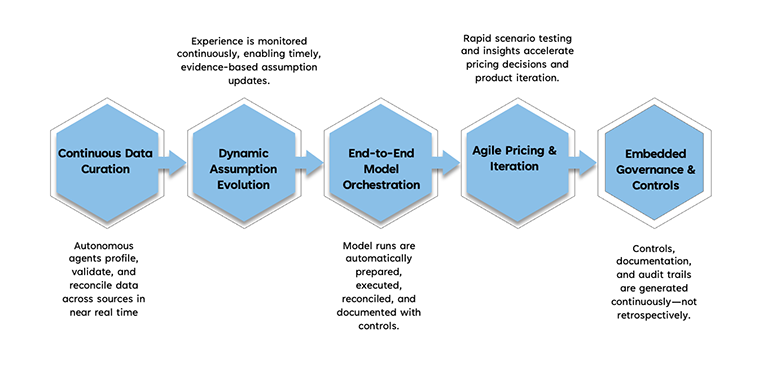
This transformation moves actuaries closer to their highest-value role: Strategic risk architects, supported by intelligent systems that handle complexity without sacrificing control.
The Human Dimension: New Skills, Ethics and Governance
As Agentic AI becomes embedded within actuarial workflows, the skill profile of the actuary must evolve. This transformation is not about replacing technical actuarial expertise, but about expanding it to include the ability to design, supervise, and govern intelligent systems. Actuaries will increasingly operate in hybrid environments where human judgment and autonomous agents work in tandem, each performing tasks suited to their strengths.
A critical capability in this new paradigm is AI orchestration. Actuaries must be able to define objectives, constraints, and success criteria for agentic systems, ensuring that automated decisions align with business intent and regulatory expectations. This includes understanding how agents sequence tasks, escalate exceptions, and adapt to new information. Rather than manually executing processes, actuaries will oversee workflows that are dynamically executed by AI, intervening only where professional judgment is required.
Equally important is data and model interpretability. As agentic systems make recommendations—whether related to assumption shifts, anomalous results, or emerging experience trends—actuaries must be able to critically assess these outputs. This requires fluency in interpreting AI-generated insights, distinguishing signal from noise, and validating conclusions against actuarial principles and domain knowledge. The ability to challenge AI output becomes as important as the ability to produce results.
Another emerging skill area is exception-based decision-making. In an agent-driven environment, routine scenarios are handled autonomously, while edge cases and material deviations are escalated for human review. Therefore, actuaries should strive to be comfortable operating at a higher level of abstraction—focusing on materiality, risk thresholds, and impact analysis rather than transactional detail. This represents a shift from process execution to risk-based oversight.
Finally, communication skills take on heightened importance. Actuaries will increasingly be required to explain AI-assisted outcomes to stakeholders such as management, auditors, and regulators. This includes articulating how conclusions were reached, what controls were applied, and where human judgment was exercised. Clear, defensible communication becomes essential to maintaining trust in AI-enabled actuarial processes.
In summary, the actuary of the future is not defined by mastery of algorithms alone, but by the ability to integrate actuarial judgment with intelligent systems. Developing these hybrid skills will be essential for actuaries to remain effective, credible, and influential in an increasingly autonomous operating environment.
The Future: Actuarial Intelligence in an Agentic World
Agentic AI is no longer a future concept; it is already influencing how actuarial work is performed. The central question facing the profession is not whether AI will transform actuarial practice, but how actuaries will guide that transformation responsibly. As autonomous systems become embedded across data, modeling, pricing, and reporting, actuarial leadership will be defined by intentional design rather than passive adoption.
In this new environment, actuaries evolve from model builders into intelligent architects. Their value lies in designing how agentic systems operate within actuarial workflows, defining boundaries for autonomy, and ensuring that professional judgment, governance, and accountability remain central. The focus shifts from producing individual results to creating trustworthy systems that consistently produce reliable outcomes.
Trust will become the defining currency of the actuarial profession. As stakeholders rely on AI-assisted outputs, actuaries will be expected to explain how conclusions were reached, what uncertainties remain, and when human intervention is required. Through strong validation practices, transparent communication, and ethical stewardship, actuaries are uniquely positioned to safeguard confidence in automated decision-making.
Beyond efficiency, Agentic AI expands the strategic contribution of actuaries. Continuous insight into emerging risks, richer scenario analysis, and faster innovation cycles allow actuaries to advise business leaders with greater foresight and relevance. To realize this potential, professional bodies, regulators, employers, and actuaries themselves must invest in new standards, skills, and operating models.
Profession Poised for Reinvention
Agentic AI does not diminish the actuarial profession—it expands its horizon.
As AI systems take on operational complexity, actuaries rise into roles requiring judgment, ethics, strategic insight, and stewardship.
The future belongs to actuaries who can say:
“I don’t just use AI—I design how AI shapes risk decisions responsibly.”
This is not the end of actuarial work.
It is the start of a more strategic, more human, and more impactful actuarial profession.
This article is provided for informational and educational purposes only. Neither the Society of Actuaries nor the respective authors’ employers make any endorsement, representation or guarantee with regard to any content, and disclaim any liability in connection with the use or misuse of any information provided herein. This article should not be construed as professional or financial advice. Statements of fact and opinions expressed herein are those of the individual authors and are not necessarily those of the Society of Actuaries or the respective authors’ employers.
Neetanjali Negi is a lead actuarial consultant in the BFSI Actuarial Services unit at Tata Consultancy Services Ltd. and is based in Bangalore, India. Neetanjali can be contacted at Neetanjali.Negi@tcs.com.
AI Assistance Disclosure
This article was developed with the assistance of an AI-based language tools to support drafting, structuring, and refinement of content.